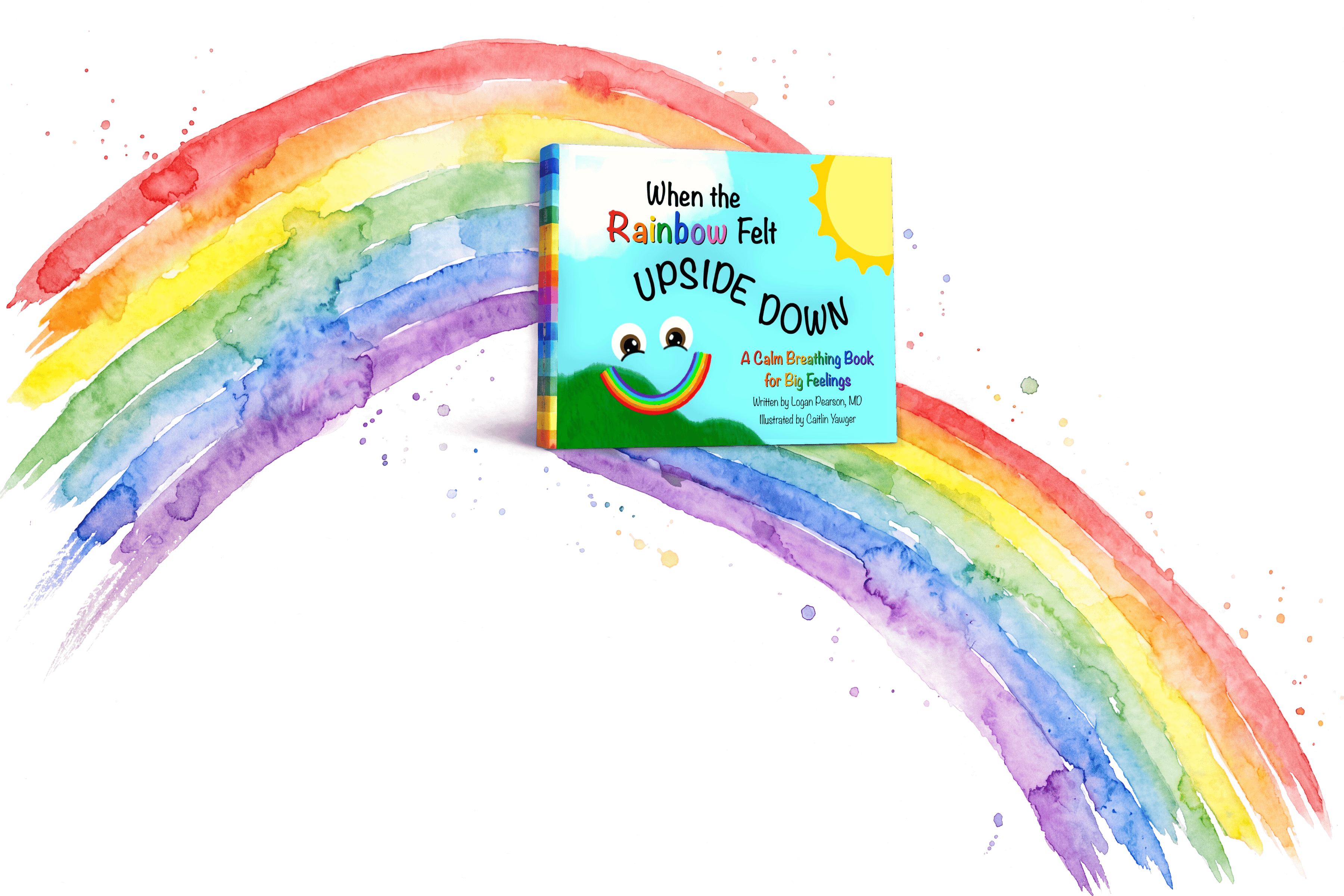
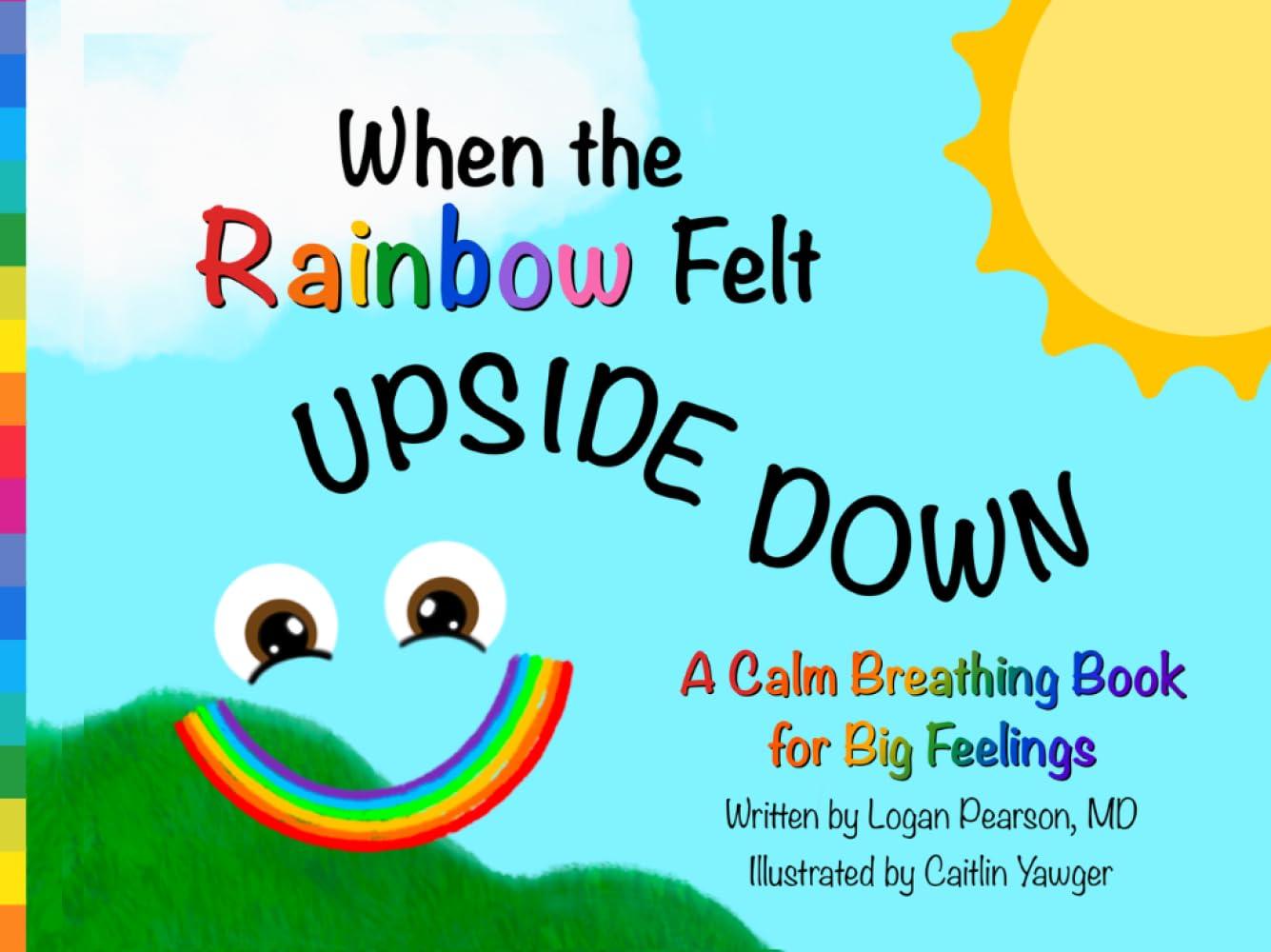
When the Rainbow Felt Upside Down
A Calm Breathing Book for Big Feelings
- Written by
- Logan Pearson, MD
- Illustrated by
- Caitlin Yawger
- Available in
- English and Spanish
this book practices
emotion regulationemotion regulation
/ɪˈmoʊ.ʃən ˌrɛɡ.jəˈleɪ.ʃən/ noun
See also paced breathingpause
Editions EnglishEspañol
1 / in the story /
When big feelings feel overwhelming, even a rainbow can feel upside down.
This gentle story helps children learn a simple way to slow down, breathe, and feel safe in their bodies again.

2 / how the book practices it /
Box breathing
Box breathing is one equal-count pattern of paced breathing. [16]
- 1 inhaleIn for 4quiet and free.
- 2 pauseHold for 4count with me.
- 3 exhaleOut for 4soft, cool breeze.
- 4 pauseHold for 4calm as can be.






3 / this book practices /
emotion regulation

/ɪˈmoʊ.ʃən ˌrɛɡ.jəˈleɪ.ʃən/ noun
Emotion regulation is the set of processes that start, maintain, or change an emotion: how strongly it is felt, how long it lasts, and how it is expressed. Regulating a feeling is not the same as getting rid of it. [1]
See also
4 / why it matters /
Interventions targeting emotion-regulation skills have produced modest improvements in youth with mental-health symptoms. [8]
4.1 the evidence for the box
The pediatric evidence supports broader slow, deep, diaphragmatic, and paced-breathing practices. The exact equal-count box pattern has not been established as uniquely beneficial in children, [16–18] so we use the box as a simple structure for practicing the broader skill.
This research concerns the skill. The book itself has not been tested as a treatment.
6 / companion resources /
To print and use alongside the book, at home, in a classroom, or in a clinic.
Activity sheet
Square Breathing: Let's Find Our Rhythm
Download PDF (1.8 MB): Square Breathing: Let's Find Our RhythmCaregiver guide
Helping Children Practice Calm Breathing
Download PDF (1.9 MB): Helping Children Practice Calm Breathing
See alsoMore ways to practice, Resources
1 / in the story /
When big feelings feel overwhelming, even a rainbow can feel upside down.

Big feelings can turn anyone's day upside down, even a rainbow's. In this gentle picture book, the rainbow finds a simple way back to feeling steady and safe: breathing in, holding, breathing out, and holding again, one count of four at a time.
Short, rhythmic verses invite children to count along, so the story becomes something a child and a grown-up can share, and come back to whenever feelings get big.
2 / the skill /
emotion regulation
/ɪˈmoʊ.ʃən ˌrɛɡ.jəˈleɪ.ʃən/ noun
Emotion regulation is the set of processes that start, maintain, or change an emotion: how strongly it is felt, how long it lasts, and how it is expressed. Regulating a feeling is not the same as getting rid of it. []
Box breathing is one kind of paced breathing: in for four, hold for four, out for four, hold for four. [] Slowing the breath to a steady count gives a child something to do while a big feeling is happening. It does not make the feeling go away; it turns it down a little and leaves room to choose what comes next. That is emotion regulation in practice.
Why it matters
Interventions targeting emotion-regulation skills have produced modest improvements in youth with mental-health symptoms. []
Box breathing is one equal-count pattern of paced breathing. []
the evidence for the box
The pediatric evidence supports broader slow, deep, diaphragmatic, and paced-breathing practices. The exact equal-count box pattern has not been established as uniquely beneficial in children, [, , ] so we use the box as a simple structure for practicing the broader skill.
3 / how the book practices it /
Box breathing
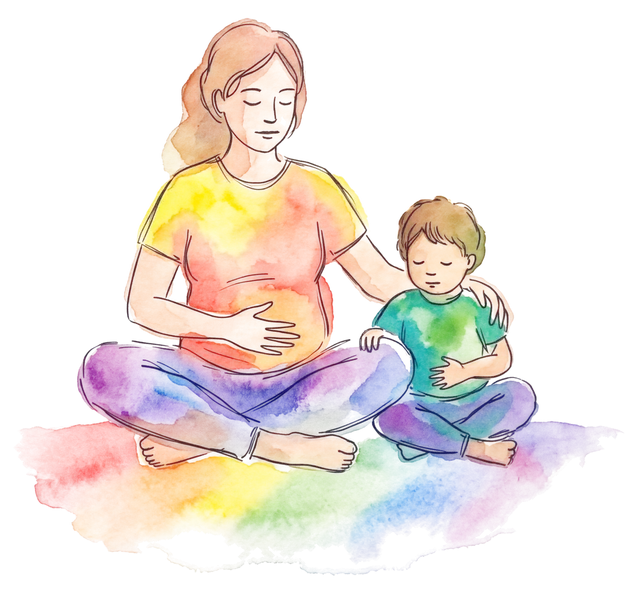
The book practices box breathing with a short verse for each side of the square: in for four, hold for four, out for four, hold for four.
- 1 inhaleIn for 4quiet and free.
- 2 pauseHold for 4count with me.
- 3 exhaleOut for 4soft, cool breeze.
- 4 pauseHold for 4calm as can be.
4 / companion resources /
Companion resources

See also More ways to practice, Resources
Book details
- Format
- Paperback
- Languages
- English, Español
- ISBN
- 979-8996888504 (English)
979-8996888511 (Español) - Publisher
- Building Blocks Books
Source 1
Morris AS, Silk JS, Steinberg L, Myers SS, Robinson LR. The Role of the Family Context in the Development of Emotion Regulation. Soc Dev 16(2):361-388. 2007.
Source 2
Dujawara A, Ali K, Kumari S. Systematic Review of Randomised Controlled Trials Evaluating Box Breathing for Stress, Autonomic, and Clinical Outcomes. Appl Psychophysiol Biofeedback. 2026.
Source 3
Moltrecht B, Deighton J, Patalay P, Edbrooke-Childs J. Effectiveness of current psychological interventions to improve emotion regulation in youth: a meta-analysis. Eur Child Adolesc Psychiatry 30(6):829-848. 2021.
Source 4
Riedl EM, Bracklo T, Wimmer K, Perzl J, Gdynia HJ, Thomas J, et al. Simply breathing anxiety away? A pilot, just-in-time ecological momentary intervention study of one-minute cyclic sighing versus box breathing as tools for acute anxiety reduction and attention promotion in real life. Anxiety Stress Coping 39(5):608-622. 2026.
Source 5
Marchant J, Khazan I, Cressman M, Steffen P. Comparing the Effects of Square, 4-7-8, and 6 Breaths-per-Minute Breathing Conditions on Heart Rate Variability, CO2 Levels, and Mood. Appl Psychophysiol Biofeedback 50(2):261-276. 2025.